How Much Does Alto 800 Insurance Cost?
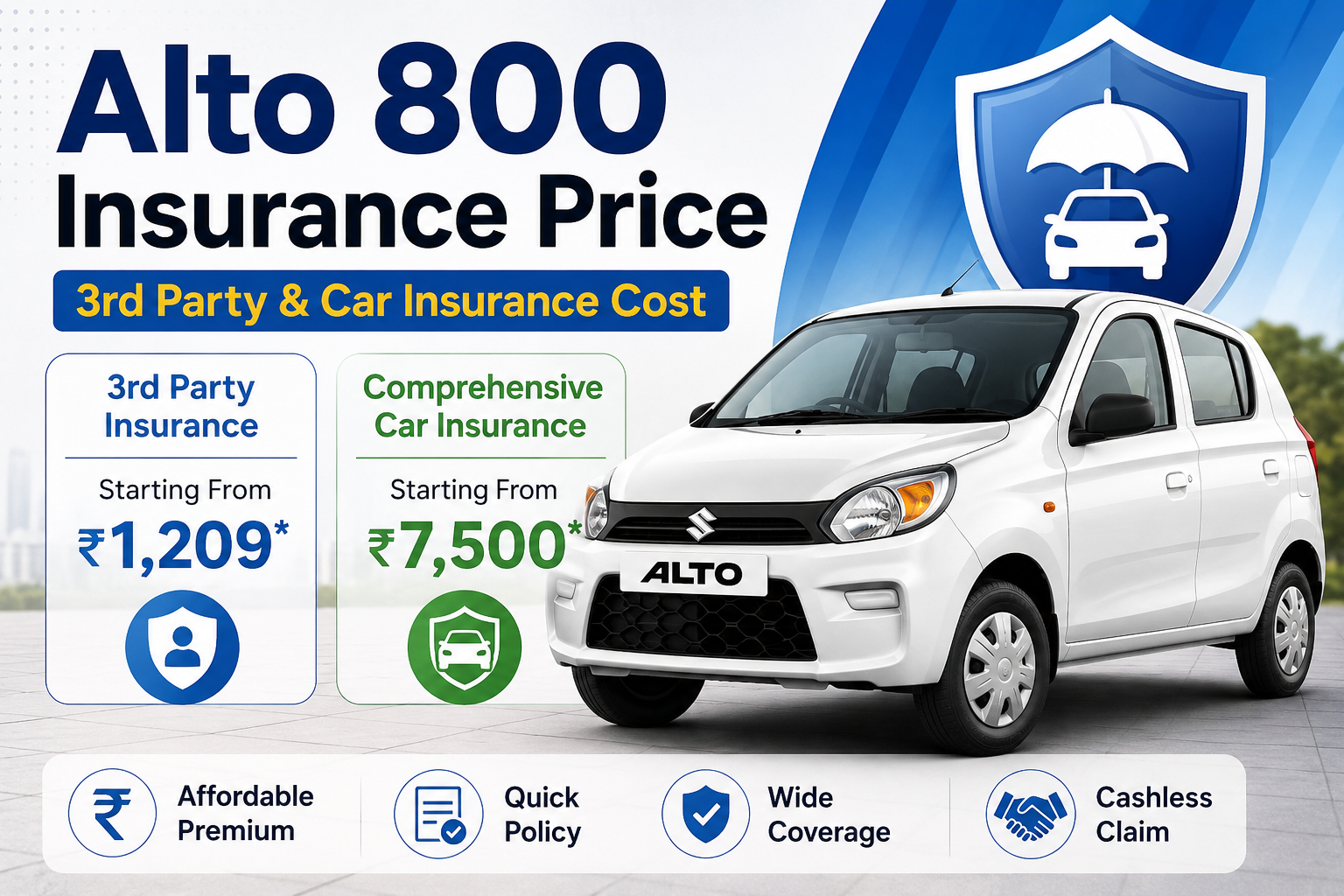
The good news is that calculating the basic third-party premium for an Alto 800 is relatively simple because the car’s engine capacity is 796 cc. It therefore falls into the private-car category of not exceeding 1,000 cc. The currently published third-party premium for this category is ₹2,094 for a one-year policy before GST. With 18% GST, that works out to approximately ₹2,471. Published insurer information confirms the ₹2,094 base premium for private cars below 1,000 cc, while IRDAI explains that third-party premiums are regulated rather than individually priced by each insurer.
That figure, however, is not the same as the price of comprehensive insurance. A comprehensive policy combines third-party liability protection with cover for damage to your own Alto 800. Its price is influenced by factors such as the car’s age, insured declared value, location, policy history, claims, deductibles, selected add-ons, and the insurer’s own pricing for the own-damage component. IRDAI specifically advises consumers to compare premiums together with deductibles, coverage, and IDV rather than choosing a policy simply because it displays the lowest price.
This guide explains the Alto 800 insurance price for third-party cover, how comprehensive insurance differs, what affects the final premium, how GST and optional covers change the bill, and how to choose an appropriate policy without paying for protection you do not need.
Alto 800 Insurance Price 3rd Party: Current Premium Estimate
“`
The Alto 800 has a 796 cc engine, which places it below the 1,000 cc threshold used for the private-car third-party premium slab. The currently published one-year base third-party premium for private cars not exceeding 1,000 cc is ₹2,094. Major insurance providers continue to display this figure in their current motor-insurance information.
| Item | Approximate Amount | What It Means |
|---|---|---|
| Alto 800 engine capacity | 796 cc | Falls within the up-to-1,000 cc private-car slab |
| One-year third-party base premium | ₹2,094 | Regulated third-party premium before applicable taxes |
| 18% GST on ₹2,094 | About ₹377 | Tax component |
| Approximate total | About ₹2,471 | Indicative one-year third-party amount including 18% GST |
The approximately ₹2,471 figure is a useful budgeting number rather than a guaranteed checkout price. Insurance quotations can include other mandatory or policy-specific components, and regulatory rates can be revised. For that reason, the final quotation issued when you purchase or renew the policy should always be treated as authoritative.
IRDAI states that third-party liability insurance is mandatory for vehicles plying on public roads in India. It also distinguishes liability-only cover from comprehensive or package insurance, with the latter adding protection for the insured vehicle itself.
“`
What Does Third-Party Insurance Cover for an Alto 800?
“`
Third-party car insurance is fundamentally a liability policy. Its purpose is to protect you financially when your Alto 800 causes injury, death, or qualifying property damage to another party.
For example, imagine that you are driving your Alto 800 and accidentally hit another vehicle at an intersection. The third-party section of your motor policy is designed to respond to eligible liability arising from that incident, subject to the terms, conditions, exclusions, and applicable law.
IRDAI explains that third-party liability cover applies to injuries and damages caused to others for which the insured is responsible. It also states that third-party injury or death liability is unlimited, while third-party property damage is generally covered up to ₹7.5 lakh under the standard framework, with an option to restrict property-damage liability to ₹6,000 in exchange for a lower liability-only premium.
What Third-Party Insurance Does Not Usually Cover
The biggest misconception about a third-party policy is that it pays for repairs to your own Alto 800. It does not provide ordinary own-damage protection for your vehicle.
If your car is damaged because of a collision, flood, fire, theft, storm, vandalism, or another covered event, a third-party-only policy generally does not reimburse the cost of repairing or replacing your own vehicle. Protection for your car requires an own-damage or comprehensive/package policy.
“`
Third-Party vs Comprehensive Insurance for Alto 800
“`
Choosing between third-party and comprehensive insurance depends less on the name of the car and more on how much financial risk you are willing to retain yourself.
| Feature | Third-Party Only | Comprehensive / Package |
|---|---|---|
| Third-party injury/death liability | Yes | Yes |
| Third-party property damage | Yes, subject to applicable limits | Yes, subject to applicable limits |
| Accidental damage to your Alto 800 | No | Generally yes, subject to policy terms |
| Theft of your Alto 800 | No | Generally yes |
| Fire and certain natural perils | No own-car protection | Generally covered, subject to terms |
| Own-damage add-ons | Generally not applicable | Available depending on insurer and policy |
IRDAI recommends considering comprehensive/package or standalone own-damage coverage in addition to mandatory liability protection when you want protection against loss or damage to the insured vehicle.
When Third-Party-Only Cover May Make Sense
Third-party-only insurance can be appropriate when your objective is to meet the mandatory legal requirement at the lowest regulated liability premium. It may also appeal to owners of older cars who prefer to pay for their own repairs directly rather than paying a larger annual premium for own-damage coverage.
That decision should still be based on the vehicle’s real value and your ability to absorb an unexpected repair bill. An inexpensive policy is not automatically the most economical policy if one accident could create a major out-of-pocket expense.
When Comprehensive Cover May Be Better
Comprehensive insurance is worth considering when your Alto 800 has meaningful remaining market value, is used regularly, is parked in an area with higher accident or theft exposure, or would be difficult to replace after a major loss.
It can also be useful if you would rather transfer much of the financial risk of damage, theft, fire, or natural events to an insurer instead of paying for such losses yourself.
“`
How Is the Alto Car Insurance Price Calculated?
“`
There is no single universal “Alto insurance price” for every owner. The third-party portion is comparatively standardized because it is based on the engine-capacity slab. The own-damage component is much more personalized.
1. Engine Capacity
The Alto 800’s 796 cc displacement places it under the 1,000 cc slab. This is why its basic annual third-party premium is considerably lower than cars in the 1,001–1,500 cc and above-1,500 cc categories. The currently published private-car rates are ₹2,094, ₹3,416, and ₹7,897 respectively.
2. Age of the Vehicle
Vehicle age matters particularly for own-damage insurance because the insurer assesses the vehicle’s depreciated value and risk profile. An older Alto 800 will generally have a lower IDV than a newer example of the same variant.
Lower IDV can reduce the premium, but selecting an artificially low IDV merely to reduce the bill can leave you underinsured after a total loss. IRDAI advises buyers to compare IDVs in addition to premiums and deductibles.
3. Insured Declared Value
Insured Declared Value, or IDV, is an important concept in own-damage car insurance. It broadly represents the insured value assigned to the vehicle for applicable total-loss or theft settlements, subject to policy conditions.
As an Alto 800 ages, its IDV normally decreases. Consequently, a five-year-old car and a two-year-old car can produce different comprehensive premium quotes even when both are the same model.
4. Registration Location
Your RTO and location can affect insurance pricing. Insurance companies use geographic risk and claims experience as part of their pricing models for own-damage coverage.
That is why a premium displayed for an Alto 800 registered in Delhi may not match a quote for the same year and variant registered in Bengaluru, Pune, Mumbai, Kolkata, or another city.
5. Previous Claims
Your claims record can influence the cost of the own-damage portion. A history with no claims may allow you to retain a No Claim Bonus, while a claim can affect the discount available on a future policy.
IRDAI notes that NCB is applied to the own-damage premium rather than the third-party liability premium and can progressively increase up to 50% under the applicable framework.
6. Deductibles
A deductible is the part of an eligible claim that you agree to bear yourself. Higher voluntary deductibles can reduce an own-damage premium, but they also mean more out-of-pocket expense when a claim occurs.
The cheapest quoted premium is therefore not necessarily the best-value quote. Two policies may look similar at first glance but differ substantially in deductible, IDV, exclusions, add-ons, and claim-related conditions.
7. Add-Ons
Add-ons can raise the Alto car insurance price but may provide valuable additional protection. Depending on the insurer and vehicle eligibility, common options can include zero depreciation, roadside assistance, engine protection, consumables cover, key replacement, return-to-invoice, and other enhancements.
Not every add-on is worthwhile for every Alto 800. The correct question is not “Which policy has the most features?” but “Which features address risks I am genuinely likely to face?”
“`
Alto 800 Third-Party Insurance Price With GST
“`
Search results often create confusion because one website may display ₹2,094 while another may show a larger checkout amount. The reason is that displayed insurance prices can differ in whether taxes and additional components are included.
For the up-to-1,000 cc private-car category, a ₹2,094 base premium plus 18% GST produces an approximate tax-inclusive amount of ₹2,471:
₹2,094 × 18% = ₹376.92 GST
₹2,094 + ₹376.92 = ₹2,470.92
Some insurer pages explicitly describe ₹2,094 as the premium before 18% GST.
This calculation is useful when comparing quotes because it prevents you from assuming that two displayed numbers are directly comparable. Always look for a premium breakup showing base premium, GST, own-damage premium, add-ons, discounts, and the final payable amount.
“`
How to Buy or Renew Alto 800 Insurance Online
“`
Buying or renewing insurance for an Alto 800 is generally straightforward, but accuracy matters more than speed. An incorrect registration number, variant, fuel type, previous-policy detail, or claims record can affect the quote and potentially create problems later.
Step 1: Keep Your Vehicle Details Ready
Have your registration certificate, previous insurance policy, registration number, vehicle variant, year of manufacture, and other relevant details available. IRDAI notes that insurers commonly require information such as registration details, engine and chassis information, cubic capacity, seating capacity, and previous claim history.
Step 2: Choose the Coverage Type
Decide whether you need third-party-only, standalone own-damage, or comprehensive/package insurance. This decision has a larger effect on your premium than simply choosing a different insurer for the regulated liability component.
Step 3: Compare the Quote Details
Do not compare only the headline premium. Check:
- Third-party premium
- Own-damage premium
- IDV
- Deductible
- NCB
- Selected add-ons
- Taxes and final payable amount
- Claim and service conditions
Step 4: Check the Policy Wordings
Before paying, read the coverage and exclusions. A short policy description on a comparison page cannot replace the insurer’s actual policy wording, terms and conditions, and customer information sheet.
Step 5: Verify the Final Policy
After purchase or renewal, review the issued policy document. Confirm the registration number, engine and chassis details where applicable, policy period, vehicle information, insured name, coverage type, IDV, and add-ons.
“`
How to Reduce Your Alto Car Insurance Price Without Sacrificing Important Cover
“`
Reducing insurance costs is sensible, but cutting coverage indiscriminately can create a false economy. The goal should be to remove unnecessary costs while keeping financially important protection.
Compare Multiple Quotes
IRDAI itself recommends shopping around and obtaining multiple comparison quotes. It specifically warns consumers not to judge policies purely by premium because deductibles, coverage, and IDV may differ.
Use Your NCB Correctly
If you have accumulated a No Claim Bonus, make sure it is reflected correctly during renewal. NCB applies to the own-damage premium rather than the mandatory third-party premium.
Avoid Unnecessary Add-Ons
Add-ons should solve a specific problem. Adding several features simply because they are available can inflate the final premium without delivering meaningful value for an older, low-value Alto 800.
Review the Deductible
A higher voluntary deductible can lower premium, but it makes sense only when you can comfortably pay that amount after an accident. The right deductible depends on your emergency savings and tolerance for repair expenses.
Renew Before the Policy Lapses
IRDAI advises policyholders to approach the insurer at least 15 days before expiry. It also states that a break in insurance can trigger an inspection requirement.
“`
Common Mistakes When Buying Alto 800 Insurance
“`
Mistake 1: Looking Only at the Cheapest Number
A low premium may correspond to lower IDV, higher deductible, fewer add-ons, or different terms. A better comparison looks at the total risk transferred to the insurer.
Mistake 2: Assuming Third-Party Insurance Covers Your Alto
Third-party insurance protects you against qualifying liabilities to other parties. It does not ordinarily repair your own vehicle following an accident.
Mistake 3: Ignoring IDV
For own-damage policies, IDV can have a major effect on the financial outcome following theft or a total loss. The cheapest policy may not have the most suitable IDV.
Mistake 4: Buying Too Many Add-Ons
More coverage is not automatically better. Add-ons should correspond to your vehicle’s age, usage pattern, location, and likely risks.
Mistake 5: Forgetting the Policy Expiry Date
A lapsed policy can expose you to uninsured risk and may result in additional inspection requirements. Set a renewal reminder well before the expiry date.
Mistake 6: Entering Incorrect Vehicle Details
Insurance relies on accurate vehicle and policy information. Incorrect data can cause incorrect pricing or complications during claims.
“`
Alto 800 Insurance for Older Cars: Is Comprehensive Cover Still Worth It?
“`
This is one of the most practical questions for Alto 800 owners because many vehicles on Indian roads are several years old.
As the car ages, the value of its own-damage protection naturally changes. At some point, the annual premium, deductible, and likely claim benefit should be considered alongside the car’s current market value and your financial ability to replace it.
For a relatively low-value older Alto 800, some owners may reasonably choose third-party-only cover while paying for minor repairs themselves. Others may still prefer comprehensive protection because theft, major collision damage, or natural calamity losses could be financially difficult to absorb.
There is no universal age at which comprehensive insurance suddenly becomes “not worth it.” The decision should reflect the current IDV, annual premium, deductible, condition of the vehicle, how frequently you drive, where you park, and the cost of replacing the car.
“`
Example: Comparing Two Alto 800 Insurance Strategies
“`
Consider an older Alto 800 with a relatively modest current market value.
Scenario A: Third-Party Only
The owner chooses the regulated third-party policy. The base premium for the up-to-1,000 cc slab is ₹2,094, with applicable GST bringing the basic amount to roughly ₹2,471. The owner accepts responsibility for repairing their own car after an accident.
This strategy keeps the recurring premium low but leaves the owner exposed to own-damage expenses.
Scenario B: Comprehensive Cover
The second owner buys comprehensive coverage. The price is higher because it includes the third-party component plus own-damage protection. The exact own-damage premium depends on the vehicle’s age, IDV, location, claims record, insurer, and selected options.
The second owner pays more every year but has a wider range of protection against covered damage to the vehicle.
Neither decision is automatically correct. The right choice depends on risk tolerance and financial circumstances.
“`
Does the Insurer Matter for Alto 800 Third-Party Insurance?
“`
For the regulated third-party liability component, insurers use the notified premium structure according to the applicable vehicle category. IRDAI states that third-party premiums are laid down by the regulator and are the same across insurers under the applicable rate structure.
That does not mean every insurer will produce the same final quote for a comprehensive policy. Own-damage pricing, discounts, service features, add-ons, deductibles, IDV options, and claim processes can differ.
Therefore, when comparing comprehensive insurance, focus on the complete policy rather than assuming the insurer with the lowest advertised price is automatically the best option.
For more research, readers can consult the IRDAI motor insurance guidance and the IRDAI rules and notifications. These provide authoritative regulatory information that should take priority over generic comparison articles.
“`
Alto 800 Insurance Renewal: What Changes Every Year?
“`
Renewal is not simply a payment exercise. It is an opportunity to reassess whether your existing coverage remains appropriate.
At each renewal, review the vehicle’s age, IDV, NCB, deductible, add-ons, claims history, annual mileage, parking location, and any change in how the car is used.
For example, an owner who previously purchased zero-depreciation coverage for a newer Alto 800 may decide that the add-on provides less value as the vehicle becomes older, depending on the policy’s eligibility rules and pricing.
Likewise, an owner who moved from a low-risk residential area to a dense urban location may place greater importance on roadside assistance or accident support.
The ideal policy can therefore change over time even though the car itself has not changed.
“`
Frequently Asked Questions About Alto 800 Insurance Price
“`
What is the third-party insurance price for an Alto 800?
The Alto 800 has a 796 cc engine, so it falls under the private-car category up to 1,000 cc. The currently published one-year third-party base premium for this category is ₹2,094 before GST. With 18% GST, the approximate amount is ₹2,471.
Is third-party insurance mandatory for an Alto 800?
Yes. Third-party liability insurance is mandatory for vehicles plying on public roads in India, according to IRDAI.
Does third-party insurance cover damage to my Alto 800?
No. Third-party insurance primarily covers qualifying liability to other parties. Damage to your own car generally requires own-damage or comprehensive/package insurance.
Why does my Alto 800 comprehensive insurance cost more than ₹2,094?
₹2,094 is the regulated base third-party premium for private cars up to 1,000 cc. A comprehensive policy also includes own-damage coverage, whose pricing is influenced by vehicle value, age, location, claims history, IDV, deductible, and insurer-specific pricing.
Does the Alto 800’s 796 cc engine affect insurance price?
Yes. Engine capacity determines which regulated third-party premium slab applies. Because 796 cc is below 1,000 cc, the Alto 800 falls into the lowest private-car engine-capacity slab for standard third-party pricing.
Can I buy only third-party insurance for my Alto 800?
Yes. Third-party liability insurance is the mandatory minimum motor insurance cover. However, it does not provide ordinary own-damage protection for your car, so comprehensive or own-damage insurance may be worth considering depending on the vehicle’s value and your circumstances.
Does No Claim Bonus reduce the Alto 800 third-party premium?
Generally, NCB applies to the own-damage portion rather than the mandatory third-party liability premium. Therefore, an NCB benefit does not normally reduce the regulated third-party base rate.
Can the Alto 800 insurance price change by city?
Yes, especially for own-damage and comprehensive coverage. Vehicle location and RTO details are among the factors insurers consider when calculating an own-damage premium.
Should an old Alto 800 have comprehensive insurance?
It depends on the car’s current value, premium, deductible, usage, parking location, and your ability to pay for repairs or replacement yourself. There is no single age at which comprehensive insurance becomes unsuitable for every Alto 800.
What information is needed for an Alto insurance quote?
Typically, insurers may ask for registration information, vehicle details, engine capacity, variant, previous insurance details, claim history, and other proposal information. Having your RC and previous policy ready makes quotation and renewal easier.
What happens if my Alto 800 insurance expires?
A policy lapse means you may no longer have valid insurance cover. IRDAI notes that a break in insurance can result in a vehicle inspection requirement, so renewing before expiry is preferable.
“`
Practical Checklist Before Buying Alto Car Insurance
“`
- Confirm that the registration and vehicle details are correct.
- Confirm the engine capacity and vehicle variant.
- Decide whether third-party-only or comprehensive cover fits your needs.
- Compare at least three quotations for comprehensive insurance.
- Compare IDV, deductible, NCB, add-ons, and exclusions—not just price.
- Check whether taxes are already included in the displayed amount.
- Read the policy wording and claim conditions.
- Renew before the existing policy expires.
- Keep a digital and physical copy of the policy information.
- Reassess your coverage at every renewal rather than automatically repeating the same package.
“`
Final Takeaway: What Should You Budget for Alto 800 Insurance?
“`
For an Alto 800 with its 796 cc engine, the simplest answer to the question “Alto 800 insurance price 3rd party” is that the currently published base third-party premium for a private car up to 1,000 cc is ₹2,094 for one year before GST. With 18% GST, the basic figure is approximately ₹2,471.
The more important answer to “Alto car insurance price” is that comprehensive insurance cannot be reduced to one fixed number. Your final premium depends on the own-damage component and the individual characteristics of the vehicle and policy.
For a cost-conscious owner, third-party-only insurance may provide the required liability protection at the lowest regulated base premium. For an owner who wants protection for the Alto itself, comprehensive or suitable standalone own-damage cover may provide better financial protection despite the higher annual cost.
The best policy is therefore not necessarily the cheapest one. It is the policy that gives you an appropriate balance between premium, liability protection, own-damage coverage, IDV, deductible, exclusions, claim support, and the actual value of your Alto 800.
Before purchasing or renewing, compare current quotations and verify the applicable premium against the latest information from IRDAI and the insurer. Regulatory rates can change, and a live quote is ultimately more reliable than an old price table.
For authoritative background, visit the IRDAI motor insurance information page. You can also review the IRDAI rules and notifications for regulatory updates.
Next step: gather your Alto 800 registration details and previous policy, compare several current quotes, and evaluate the total policy value rather than choosing solely on the lowest advertised premium.
Hi, this is a comment.
To get started with moderating, editing, and deleting comments, please visit the Comments screen in the dashboard.
Commenter avatars come from Gravatar.